Introducing Cortex

Cortex is an agentic intelligence engine that continuously collects, filters, and synthesizes information into useful outputs. It is built for people who want to maximally leverage AI agents for automating research and other applications, without sacrificing reliability.
You may be asking what an intelligence engine is? An intelligence engine is a system that combines data from multiple sources with automated analysis to produce actionable output. The concept of an intelligence engine software has existed for decades 1 , and is now associated mostly with heavy-duty, domain-specific commercial software: threat intelligence platforms, supply chain monitors, and similar platforms are usually built for large organizations with large budgets.
But the advent of agentic AI has pushed the limits of what an intelligence engine can be and who can benefit from using one. Cortex is an agentic intelligence engine: it is operated largely by AI agents. With Cortex, humans are in control, but they are not expected to manage routine setup maintenance. Instead, the human’s role is to specify their core objective for Cortex agents to follow as they build and optimize information pipelines.
The problem
Why is a tool like Cortex necessary? There are two related problems. First, the world is becoming increasingly complex. As technology advances, systems become larger, and more information is generated and scattered across the digital world. Second, rarely is source content produced and delivered according to your exact objectives. External platforms and intermediaries optimize for their own incentives and suffer from bias.
In the end, if you want to stay current on a research domain or monitor a technical system, the sheer volume of information and conflicting incentives means that there is a real difference between being “in the loop” vs actually “in command” of your project.
Existing tools don’t solve this. News aggregators aren’t as adaptive as AI agents, to say the least. Chatbots just aren’t reliable enough. Other workflow automation tools weren’t built to be truly AI first.
What is needed is a system that leverages AI to the max, but where human objectives remain central.
How Cortex works
A project in Cortex consists of three building blocks: Sources, Feeds, and Digests.
Sources are connections to external data (APIs, websites, X accounts etc). Cortex agents assist with setting up, monitoring and healing source connections.
Feeds are like gates and routes for source content. Every feed has an objective which Cortex agents use to decide if content belongs in the feed.
Digests are where feed items finally get combined into more complete, usable outputs. Cortex agents use your feeds to build briefing reports you can read or datasets you can use in your applications.
Importantly, Cortex agents don’t just run your pipeline — they optimize it. Every decision made by Cortex agents is subject to human feedback so that they can continually improve and learn the nuances of your objectives.
A real example
To see how this looks in practice, here’s a real project running on Cortex today: a blockchain infrastructure firm uses Cortex to generate high signal information feeds for research and operations.
The project pulls from hundreds of sources — news outlets, protocol blogs, research firms, academic journals, GitHub repos, and curated X lists of technical experts.
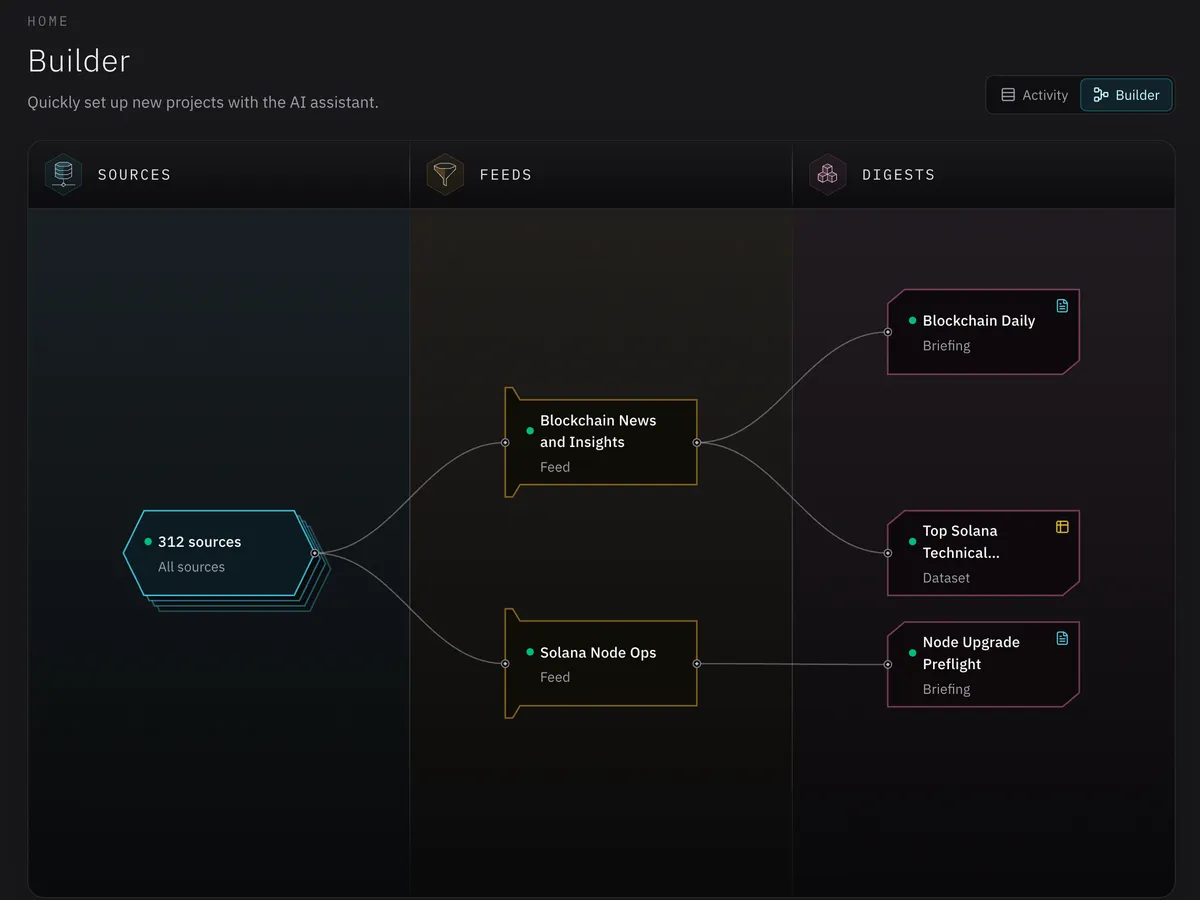
Two feeds organize this content against distinct objectives — one for collecting important blockchain news and insights, and another for technical content needed for operating a specific type of blockchain infrastructure.
Three digests produce usable outputs:

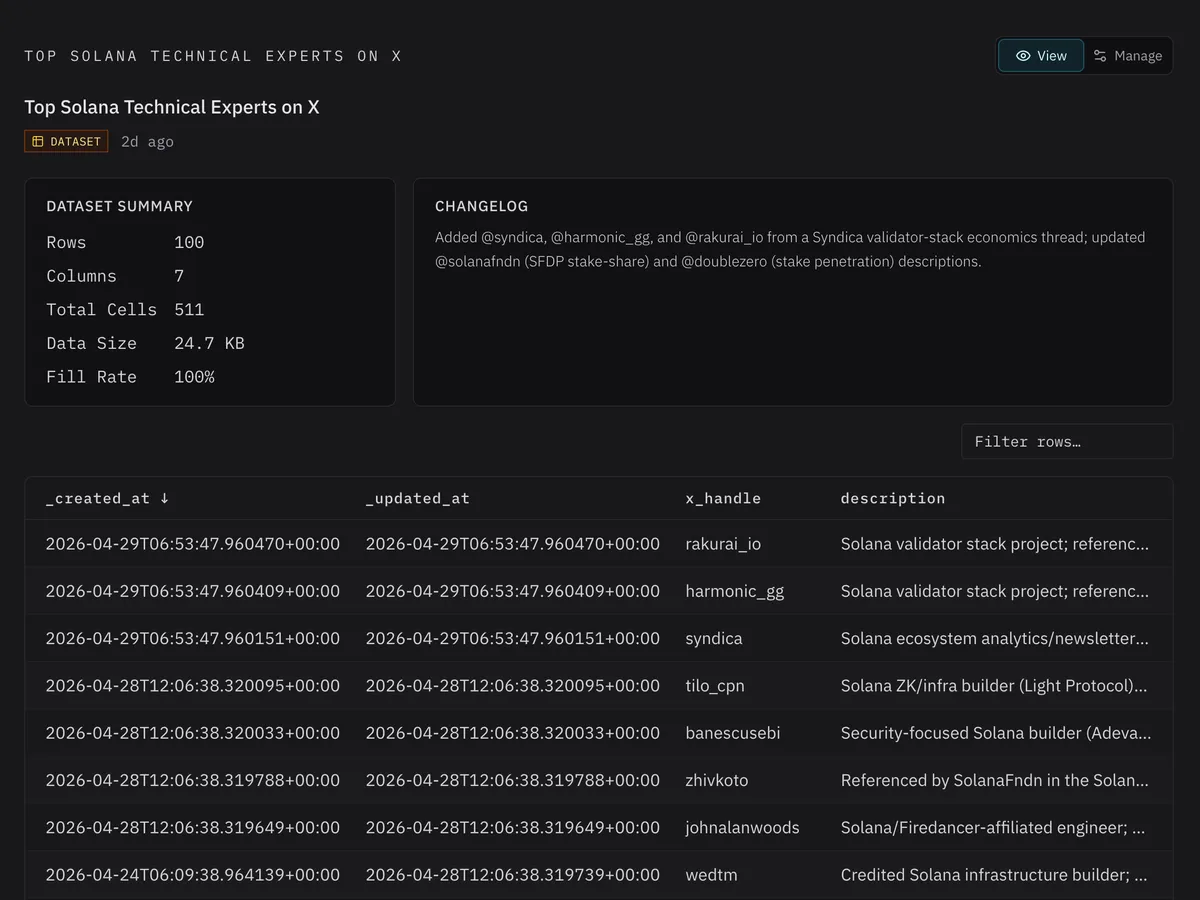
The system improves over time through continuous feedback from users viewing these outputs.
Built for everyone
Our goal is to make Cortex a powerful general-purpose tool for researchers, analysts, developers — or anyone who needs to continuously collect, filter, and act on information. In practice, that’s everyone.
You don’t need to write code to use Cortex. Workflows can be entirely configured in the UI with the Cortex Assistant.
If you want programmatic access, Cortex exposes a full API and MCP integration — this enables entire applications to be built on top of the Cortex workflow and optimization system.
What’s live now
Cortex is live today:
- Source connections for RSS, web, API endpoints, and X/Twitter
- AI-powered feed pipelines with filtering and summarization
- Briefing and dataset digest outputs
- In-app Cortex Assistant for automated setup and exploration
- Full API and MCP access for programmatic integration
- Optional bring-your-own OpenAI API key
- Public docs and example guides
What’s next
We’re early and building fast. Everything you see today will keep getting better. Follow us for the latest updates.
References
- 1US Patent 6961334B1 — Intelligence engine (Sonus Networks, 2001)worldwide.espacenet.com